How to Respond to Google Reviews: A Guide for Restaurants (with Templates and Examples)
How restaurants, cafés and hotels should reply to Google reviews: the structure of a good response, common mistakes, and templates for 5-star, 3-star and 1-star reviews.
By Viktor HolterUpdated: 8 min read
Key points
- Reply within one to two days, and to criticism first.
- Three to six sentences: greeting, thanks, a specific reference, an invitation.
- Decide who replies and when. Without an owner, reviews pile up.
- Never offer anything in return for reviews: it breaks Google’s policies.
For many guests, a restaurant visit starts on Google Maps. They see the stars, the photos, the latest reviews and, right below them, whether and how the venue replies. So your responses aren't only read by the reviewer. They're read by everyone deciding whether to book a table with you.
This guide covers why replying is worth the effort, how a good reply is structured and which mistakes to avoid. At the end you'll find templates you can adapt to your venue.
Why you should respond to Google reviews
- Visibility: Google explicitly lists review count and score as factors in local search ranking. Collecting and answering reviews signals an active, well-managed profile.
- Trust: Potential guests see that real people are listening. A calm, factual reply to criticism often does more for you than ten five-star reviews.
- Repeat visits: Someone who took the time to write a review appreciates a personal response. It's one of the simplest forms of guest loyalty.
- Damage control: With negative reviews you can clear up misunderstandings and show how you handle problems.
How quickly should you reply?
There's no fixed rule, but a good benchmark is within one to two days. Speed matters more for negative reviews, because the complaint is public without your side of the story. Still, never reply while you're angry. Take a breath, talk to your team and reply calmly the next morning.
The structure of a good reply
Good replies almost always follow the same pattern, and it only takes a few sentences:
- Greet the guest by name, using the name shown on Google.
- Say thank you for the review, even when it's critical.
- Refer to something specific they mentioned: the dish, the occasion, the service. That way the reply doesn't read as copy-paste.
- For criticism: show understanding, add brief context, say what you're changing and offer a direct line of contact.
- Invite them back and sign with your name or your team's name.
Keep it short: three to six sentences are almost always enough. Mentioning your restaurant's name and the dish or occasion is fine, since it helps people who search reviews for something specific. Don't stuff in keywords, though. It quickly sounds artificial.
The most common mistakes
- Generic replies: “Thanks for your review!” under every review looks careless. Readers can tell instantly.
- Arguing in public: You never win a public argument, even when you're right. Correct facts calmly and take the rest offline.
- Sharing personal data: No booking details, guest phone numbers or bill amounts in public replies.
- Only replying to negative reviews: If you only respond to criticism, that's where attention goes.
- Offering incentives for reviews: Discounts or free drinks in exchange for reviews violate Google’s policies. So does selectively asking only happy guests for reviews.
Reply templates
These templates are starting points, not finished texts. Replace the placeholders in square brackets and adjust tone and details to your venue. A fine-dining restaurant sounds different from a neighborhood pub.
5 stars: a delighted guest
Hi [Name], thank you so much for the kind words! We’re really glad you enjoyed [dish/evening/occasion]. We’ll pass the compliment on to [kitchen/service/name]. We look forward to welcoming you back! Warm regards, [Your name] and the team at [Restaurant]
5 stars, no text
Thanks for the five stars, [Name]! Great to have had you with us. See you next time at [Restaurant]!
3 stars: a mixed experience
Hi [Name], thank you for the honest feedback. We’re glad you liked [positive point]. We’re sorry [issue] didn’t meet your expectations. We’ve discussed it with the team and [specific action]. We’d love the chance to welcome you again and do better next time. Best, [Your name]
1 star: fair criticism
Hi [Name], we’re sorry your visit wasn’t what it should have been. [Brief, factual context, e.g.: We were short-staffed that evening and should have told you sooner.] We take your feedback seriously and have [specific action]. I’d welcome the chance to talk to you directly. You can reach me at [email/phone]. [Your name], [role]
1 star: you can’t find the guest
Hi [Name], we take every piece of feedback seriously, but unfortunately we can’t find your visit in our records. Please get in touch at [email] so we can look into it. [Your name]
For responding calmly to harsh criticism, see handling negative restaurant reviews. For when fake or abusive reviews can be removed, see how to get a Google review removed.
Reply examples for typical situations
Alongside the templates, examples for situations that come up in almost every restaurant help. They show how specific a good reply can be.
Praise for a particular dish
Dear Anna, thank you! The ossobuco is a kitchen favourite too, Marco braises it for six hours every morning. We’ll tell him it hit the spot. See you soon at Trattoria Sole!
Criticism of the wait
Hi Mr Weber, thank you for the honest feedback. On Saturday a large group took up more of the kitchen than planned. Still, 50 minutes for a main course is too long, and we should have told you sooner. We now schedule an extra cook for busy evenings. If you’d give us another chance, please get in touch with me directly at julia@trattoria-sole.com. Julia, owner
Criticism of the price
Hi Tom, thanks for the honest take. Our beef comes from a local farm and costs more than wholesale, which shows in the price. Glad you enjoyed the service. On weekdays we have a €16 lunch menu, which might be an idea next time. Best, Stefan
A review in another language
Liebe Familie Schulz, vielen Dank für Ihren Besuch und die schönen Worte! Es freut uns, dass es den Kindern bei uns gefallen hat. Bis zum nächsten Mal! Ihr Team vom Harbour Kitchen
One star, no text
Hi Mr K., we’re sorry your visit didn’t win you over. We’d like to understand what went wrong. Please write to us at hello@harbourkitchen.com and we’ll get back to you personally. The Harbour Kitchen team
For several reply suggestions to your own review in different tones, try our free Google review response generator.
Getting more reviews without breaking the rules
Replying brings more reviews, but the biggest lever is the request itself: with your direct review link, at the right moment, asking every guest and never offering anything in return. Nine allowed methods, from QR codes to a message after the visit, are in how to get more Google reviews.
Special cases no template covers
- A review in another language: reply in the guest’s language, briefly and in simple sentences. Google translates reviews and replies for other readers automatically.
- A team member is praised by name: pass it on and say so in your reply. For the team it is often the best feedback of the week.
- A team member is criticised by name: don’t comment on the person in public. Thank the guest for raising it, sort it out internally and offer a direct conversation.
- Old, unanswered reviews: start with the newest and work back through the last few months. Answer older criticism briefly without reopening the case.
- A review meant for a different venue: point out kindly that another place seems to be meant, and report the review to Google as off-topic.
- The guest edits their review: guests can edit a review at any time. Don’t push for it. If it happens, update your reply so the two still fit together.
A fixed routine for the team
We ran two cafés and a restaurant ourselves and know the problem: during service nobody has time for reviews, and afterwards nobody remembers. A fixed routine matters more than the perfect wording.
- One person is responsible, with a second as cover. Not “whoever has time”.
- A fixed slot: for example ten minutes every morning before lunch service.
- A shared tone: formal or informal, which name you sign with, and how you close. Two or three sample replies are enough as a guide.
- Criticism goes up: the owner or manager reads one- and two-star reviews before anyone replies.
- Recurring points go to the team meeting: what guests praise or criticise repeatedly belongs on the next agenda.
Frequently asked questions
Does the guest see my reply?
Yes. Your reply appears publicly under the review, and Google notifies the person who wrote it. Google explains the details under Manage customer reviews.
Can I change a reply later?
Yes. You can edit or delete your reply in your Business Profile. That makes sense once an issue has been resolved in a direct conversation.
Can I reply privately?
No. Google offers no private reply to reviews. That is why your public reply should name a way for the guest to reach you directly.
Do I have to answer every review?
There is no obligation. It makes sense to answer all new reviews and, when time is short, to start with criticism and with reviews that contain text.
Replying with AI: faster, but with approval
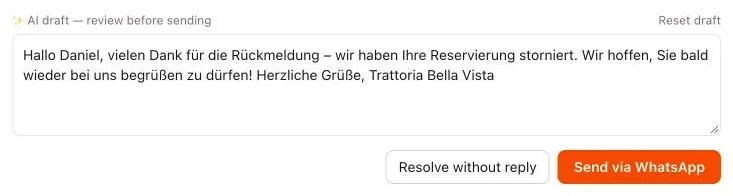
Venues with lots of reviews can easily spend hours a week replying. AI tools help by drafting a reply that refers to what the guest actually wrote and matches your venue’s tone. What matters is that a person checks every reply before it’s published, especially for criticism.
In Hospello, Google reviews land in the same inbox as WhatsApp, Instagram and email messages. Critical reviews are sorted to the top, and the AI suggests a reply your team can edit and send in one click. To see how to bring all channels together, read how to answer guest messages faster.