Negative Restaurant Reviews: How to Respond with Confidence, with Phrases and Examples
Got a bad review for your restaurant? How to respond with confidence, what to write in public, which phrases hurt and how to learn from criticism.
By Viktor HolterUpdated: 5 min read
Key points
- Check the facts with your team first, then reply. Never in anger.
- Thank, show understanding, give context, name an action, offer contact.
- Fake reviews and insults can be reported, honest criticism gets a reply.
- Reply even if you have reported the review.
Every hospitality business gets a bad review sooner or later. Sometimes it’s fair, sometimes it’s exaggerated, sometimes it’s simply wrong. What matters isn’t whether negative reviews come in, but how you deal with them, because hundreds of potential guests will read your response.
This guide shows how to respond in five steps, which phrases help and how to learn from recurring criticism. When and how to get a review removed has its own guide: how to get a Google review removed.
Check first, then reply
Before replying, answer three questions internally:
- Are the facts right? Talk to the team who worked that shift. Check bookings, receipts or notes.
- Is the criticism fair, partly fair or false? An exaggerated review often has a true core, like long waits on a busy night.
- Does the review break the rules? Insults, false statements of fact, spam or reviews without a real visit can be reported (see below).
Five steps to a confident reply
- Thank them for the feedback. It’s hard, but it tells every reader you take criticism seriously.
- Acknowledge their experience without apologizing for things outside your control. “We’re sorry you had to wait so long” is different from “We apologize for everything.”
- Add brief, factual context. One sentence is enough. No excuses, no blaming the guest.
- Name a specific action if the criticism is fair: “We’ve changed how orders flow at the pass.” That convinces readers more than any assurance.
- Take it offline. Offer an email address or phone number where you can be reached personally.
Phrases that help, and phrases that hurt
Helpful
- “Thank you for taking the time to share this.”
- “That’s not the standard we hold ourselves to.”
- “We’ve discussed this with the team and …”
- “I’d like to talk to you personally.”
Harmful
- “That can’t be right, nobody has ever complained.”
- “Other guests were very happy.”
- “You should have said something at the time.”
- Irony, sarcasm or any insinuation about the guest.
For full reply templates for different review types, see our guide on how to respond to Google reviews.
Report instead of reply: when that works
Google removes reviews that break its policies: fake reviews from people who were never guests, insults, off-topic content and reviews from competitors or former staff. Harsh but honest criticism of the food, service or price isn’t among them. There, your reply is the tool.
How to report a review, the legal side and what to do if Google says no are covered step by step in how to get a Google review removed. Our free removal check tells you whether a report is worth it.
What not to do
We know from our own venues that the review that stings most rarely arrives when you have time to answer calmly. That is exactly when these mistakes happen:
- Organising counter-reviews: five stars from friends, family or staff are a conflict of interest and break Google’s policies.
- Offering something in return for deletion: a voucher as a goodwill gesture in a direct conversation is fine. Making it conditional on the review being changed or removed is not.
- Threatening legal action in public: every future guest reads along. Deal with legal steps away from the review section.
- Making the guest identifiable: no details about the booking, table, company or bill in your reply.
- Not responding at all: to readers, unanswered criticism looks like confirmation.
Many bad reviews at once
After a row on social media or a news story, dozens of one-star reviews sometimes arrive within hours from people who were never guests. What to do:
- Don’t argue one by one. Replying to every review fuels the wave.
- Report every review that clearly has nothing to do with a visit.
- Contact Business Profile support and explain the context, with the time period and examples.
- Publish one short, factual statement in one place, for example as a post on your Business Profile.
- Document it: dated screenshots, in case you need legal steps later.
Frequently asked questions
Can I delete a review myself?
No. Only the person who wrote it can delete it, or Google after an assessment.
Should I reply if I have reported the review?
Yes. The assessment takes time and may be rejected. Until then readers only see the review. A short, factual reply is enough.
How many bad reviews are normal?
A profile with nothing but five stars looks implausible to many readers. A few critical reviews with a good reply rarely do harm. What matters is whether the same point keeps coming up.
Spotting patterns in criticism
A single negative review tells you little. Ten reviews that all mention weekend wait times tell you a lot. Collect points of criticism over a few weeks and look for repeats:
- Is the criticism tied to certain days or times? That often points to staffing.
- Is one dish or drink criticized repeatedly? Look at the recipe, portion or price.
- Do guests complain about bookings that never arrived? Then you’re missing a reliable process for requests via WhatsApp, Instagram and email.
That last one is more common than you’d think: requests arrive through many channels, and when nobody has an overview, some get lost. Our guide on answering guest messages faster shows how to prevent that.
Catch complaints before they go public
The best negative review is the one that never gets written because the problem was solved first:
- Check in at the table: not just “Everything OK?”, but genuine interest that invites honest feedback.
- A direct line after the visit: if guests can easily reach you via WhatsApp or email, they’ll vent to you rather than to Google.
- Respond to complaints fast: a complaint message left unanswered for days often turns into a public review.
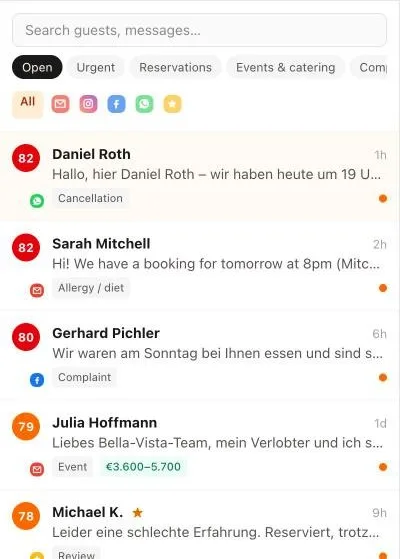
Hospello detects complaints across every channel, from Google reviews to Instagram DMs, scores their urgency and moves them to the top. The AI suggests a reply that your team reviews and sends, so no frustrated message sits unanswered.