Hotel Guest Communication: Before, During and After the Stay
How boutique hotels and guesthouses communicate with guests: enquiries, pre-arrival messages, requests during the stay, complaints, reviews and direct bookings. With templates.
By Viktor HolterUpdated: 5 min read
Key points
- Four phases: before booking, before arrival, during the stay, after departure.
- Answer direct enquiries quickly: they lead to commission-free bookings.
- A pre-arrival message answers most questions before guests ask them.
- Solve complaints on site and ask every guest for a review, not just happy ones.
Good hotel guest communication follows four phases: answer enquiries before booking quickly, send the key information a few days before arrival, solve requests and complaints during the stay right away, and say thank you and ask for a review after departure. Smaller hotels and guesthouses without a 24-hour front desk easily lose track, because questions about parking, breakfast and late arrival come in through many channels.
This guide shows how to organize communication at every stage and which messages are worth sending.
The channels in a hotel
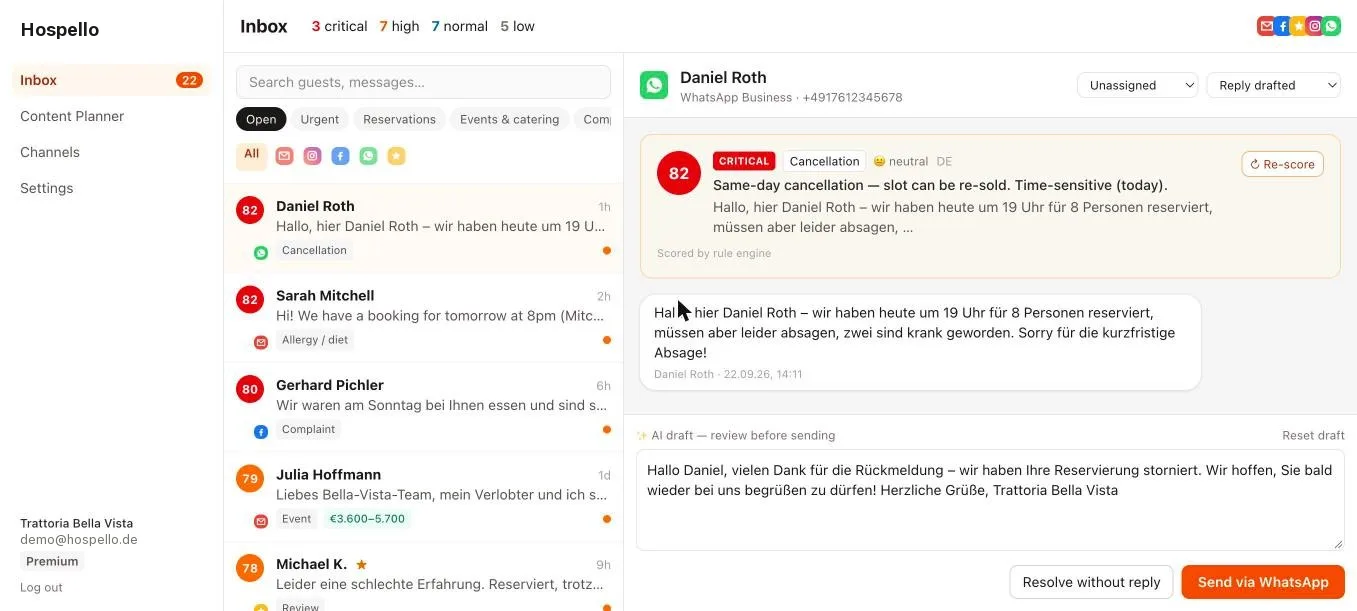
Hotels usually have even more channels than restaurants:
- Email, often the main inbox for enquiries and bookings
- WhatsApp, increasingly popular for short-notice questions and requests
- Instagram and Facebook for enquiries from guests who discover you on social media
- Google reviews and reviews on booking platforms
- Messages via booking platforms, which usually stay in each platform’s extranet
- Phone and in person at reception
The more of these come together in one place, the easier the handover between morning, evening and night shifts. Our guide on answering guest messages faster shows how.
Stage 1: Enquiries before booking
Direct enquiries by email, WhatsApp or Instagram are valuable because they lead to commission-free direct bookings. Answer them quickly and completely, with price, availability and a clear next step, such as a booking link on your website or an offer to hold the room for a short time.
Stage 2: The pre-arrival message
A message a few days before arrival answers most questions before they’re asked, and is a good moment to offer extras:
Hi [Name], we’re looking forward to welcoming you from [arrival] to [departure]! A few things in advance: • Check-in from [time], check-out by [time] • Parking: [info] • Breakfast: [times and price] • Arriving after [time]? Just let us know and we’ll arrange [key safe/night porter]. Would you like to book a table at our restaurant, or is there anything special we can prepare for your stay? Just reply to this message. Warm regards, [Name], [Hotel]
Ask about arrival time and special occasions like birthdays or anniversaries. A small gesture in the room stays with guests for a long time.
Stage 3: During the stay
Guests in their room would rather send a message than walk down to reception: extra towels, a restaurant tip, a taxi for tomorrow morning. What matters is that these messages reach the right person fast, even when reception is busy with a check-in.
Resolve complaints immediately
The most important message during a stay is a complaint. A problem solved on site usually doesn’t end up in a review. A problem ignored almost always does. Respond quickly, show understanding and offer a concrete solution: a different room, a technician, a gesture of apology.
Hi [Name], thank you for letting us know directly, and we’re sorry that [problem]. [Colleague’s name] is taking care of it right away and will get back to you within [time]. [Optional: As a small apology, we’d like to invite you for a drink at the bar this evening.] Best regards, [Name], Reception
Stage 4: After departure
A short message after departure rounds off the stay: a thank you, a request for feedback and a note on how to book direct next time. Ask every guest for a review, not only the ones you have a good feeling about. Selectively soliciting positive reviews isn’t allowed on Google. Reply to the reviews you do get as well: in a study of TripAdvisor data, hotels that started replying received 12 percent more reviews and a better average.
Hi [Name], thank you for staying with us! We hope you had a lovely time in [place]. We’d be very grateful for a short review on Google: [link] For your next stay, booking directly via [website] lets us best take care of your wishes. See you next time! [Name], [Hotel]
Then reply to every review, positive or negative. You’ll find templates in our guide on responding to Google reviews.
International guests
Hotels often host guests from many countries. Replying in the guest’s language feels attentive and prevents misunderstandings, for example about arrival times or cancellation terms. If you use translation tools, always double-check key information like prices, dates and terms.
Data protection
Hotels process a lot of personal data, including travel details, payment information and sometimes health details such as allergies or accessibility needs. Never send card details or ID copies via WhatsApp or email, only share stay details with the guest themselves, and list every channel you use in your privacy policy. The points in our guide to WhatsApp Business apply to hotels too.
Frequently asked questions
When should a hotel send the pre-arrival message?
A few days before arrival. That gives guests time to share their arrival time, parking needs or a restaurant booking, and gives you time to prepare.
Should a hotel ask every guest for a review?
Yes. Google doesn’t allow asking only happy guests for reviews. Ask everyone, for example with a short message after departure.
How should you handle a complaint during the stay?
Quickly, with empathy and a concrete fix: a different room, a technician or a small gesture of apology. A problem solved on site usually doesn’t end up in the review.
Can card details be sent by WhatsApp or email?
Avoid it. Card details and ID copies don’t belong in messengers or email but in your booking or payment system.
Lighten the load with AI
Hospello is built for restaurants, cafés, bars and boutique hotels with up to five locations. Email, WhatsApp, Instagram, Facebook Messenger and Google reviews land in one inbox shared by morning, evening and night shifts. The AI recognizes complaints and urgent requests, moves them to the top and suggests replies in the guest’s language, based on your knowledge base with check-in times, parking and breakfast. Your team reviews and sends. Messages from booking platforms stay in those platforms’ own systems.