Allergen Labelling on Restaurant Menus: The 14 Major Allergens and How to Declare Them
Which allergens restaurants in the EU and UK must declare, how to show them on the menu or verbally, and how to answer guests’ allergy questions safely.
By Viktor HolterUpdated: 5 min read
Key points
- Restaurants in the EU and UK must declare 14 major allergens in food and drink.
- Allowed: codes on the menu, a separate allergen chart, or verbally backed by written records.
- The duty covers every ingredient, including bought-in products and sauces.
- Answer allergy questions from your records only, never from memory.
Yes, restaurants, cafés and bars have to declare allergens too: in the EU and the UK this covers 14 major allergens in food and drink. You can show them on the menu, in a separate allergen chart or, in several countries, verbally as long as written records exist. For guests with food allergies it’s more than a legal duty: venues that inform clearly and reliably are the ones allergy sufferers and their companions come back to and recommend.
This guide explains which allergens must be declared, your options for declaring them, and how to answer allergy questions reliably by phone, WhatsApp or email.
Is allergen labelling mandatory?
Since December 2014, the EU Food Information to Consumers Regulation (FIC, Regulation (EU) No 1169/2011) has required restaurants, cafés, bars, canteens and caterers to provide information about certain allergens in non-prepacked food and drink. Member states set the details of how this information may be given. The UK retained the same 14 allergens after Brexit, with guidance from the Food Standards Agency.
The 14 major allergens
The following 14 substances or groups, and products made from them, must be declared:
- Cereals containing gluten (wheat, rye, barley, oats, spelt, kamut and their hybrids)
- Crustaceans (e.g. prawns, lobster, crab)
- Eggs
- Fish
- Peanuts
- Soybeans
- Milk (including lactose)
- Tree nuts (almonds, hazelnuts, walnuts, cashews, pecans, Brazil nuts, pistachios, macadamia nuts)
- Celery
- Mustard
- Sesame
- Sulphur dioxide and sulphites (above 10 mg/kg or 10 mg/l, expressed as SO₂), e.g. in wine and dried fruit
- Lupin
- Molluscs (e.g. mussels, squid, snails)
Three ways to declare allergens
1. On the menu
The most common approach is letter or number codes next to each dish, with a key on the same page or at the end of the menu. There is no universal coding standard. What matters is that the key is clear and easy for guests to find.
2. A separate allergen chart
Many venues keep an allergen matrix: dishes in the rows, the 14 allergens in the columns. The menu stays clean, but the chart must be easy for guests to access, with a clearly visible note on the menu.
3. Verbal information backed by written records
In several countries, including Germany and the UK, allergen information may be given verbally, as long as accurate written records for each dish are readily available and a clear notice on the menu or a sign tells guests to ask staff. Check the exact rules with your local food authority.
Please speak to our staff about the ingredients in your meal if you have a food allergy or intolerance. Written allergen information is available on request.
May contain traces: cross-contact
Precautionary statements like “may contain traces of nuts” are usually voluntary, but valuable for guests with allergies. If your kitchen handles nuts, gluten or crustaceans, traces often can’t be ruled out. Say so honestly rather than calling a dish “nut-free” when it’s prepared in the same fryer or on the same board.
Keeping allergen information up to date
- Document recipes: every dish with all ingredients, including sauces, dressings and sides.
- Update with every change: a new supplier, a different bread, a new specials board. The allergen list has to follow.
- Check bought-in products: the ingredient list on the pack is your source. Keep specification sheets.
- Name one owner: usually the head chef signs off every change.
- Train the team: service and kitchen must know where the records are, and ask rather than guess.
Frequently asked questions
Which 14 allergens must be declared?
Cereals containing gluten, crustaceans, eggs, fish, peanuts, soybeans, milk, tree nuts, celery, mustard, sesame, sulphur dioxide and sulphites, lupin and molluscs, including products made from them.
Is a notice telling guests to ask staff enough?
In several countries, including Germany and the UK, yes, as long as accurate written allergen records for each dish are readily available and the notice is clearly visible. Check the exact rules with your local food authority.
Do I have to say “may contain traces”?
No, precautionary statements are usually voluntary. They are still useful if you can’t rule out cross-contact in your kitchen.
Does the duty cover drinks?
Yes. Typical examples are sulphites in wine, milk in coffee drinks and cereals containing gluten in beer.
Answering allergy questions by message
Many guests ask before they visit, via WhatsApp, Instagram or email: “Do you have gluten-free pasta?” or “My son has a nut allergy, what can he eat?” These messages are especially important and deserve a prompt, precise answer.
- Answer from your records only, never from memory.
- Mention cross-contact if you can’t rule out traces.
- Add the note to the booking so kitchen and service know on the night.
- Store health data sparingly: keep allergy details only as long as needed for the visit.
Hi [Name], thanks for your message! For guests with [allergy] we recommend [dishes]. Please note that our kitchen also handles [allergen], so we can’t completely rule out traces. We’ve added a note to your booking on [date]. Please remind your server when ordering too. See you soon!
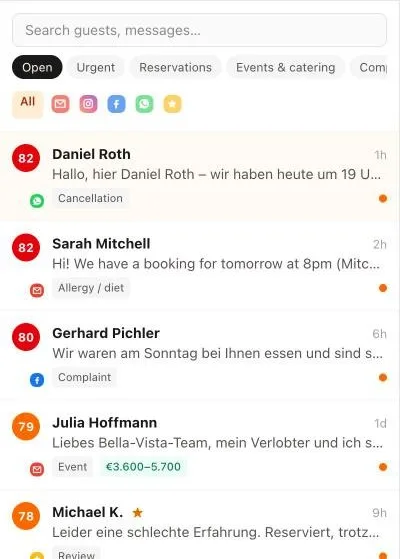
Hospello recognizes allergy questions automatically and flags them as urgent when they concern an upcoming visit. The AI drafts the reply from your knowledge base, where you store your allergen information. Your team checks every reply before sending, which is especially important for allergies. Read more about organizing guest enquiries in our guide on answering guest messages faster.